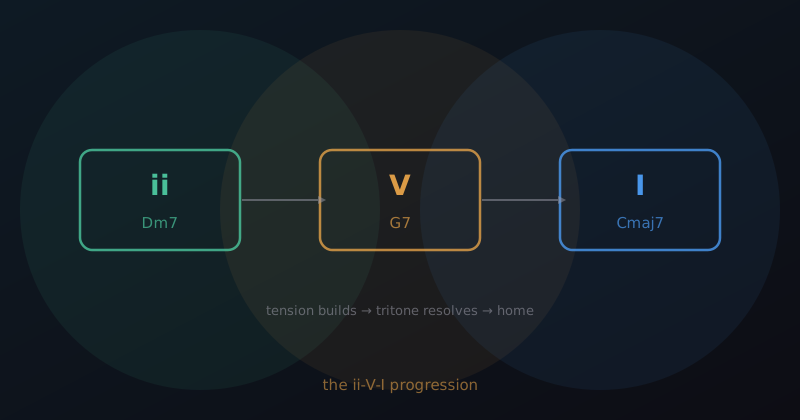
If you listen to enough jazz — any jazz, from swing to bebop to bossa nova to contemporary — you'll notice a recurring sequence: three chords that feel like a question, a tension, and an answer. In C major, those chords are Dm7 (D–F–A–C), G7 (G–B–D–F), and Cmaj7 (C–E–G–B). This is the ii-V-I, and it is the single most fundamental harmonic unit in jazz.
Understanding it reveals something deep about how jazz harmony works.
What each chord does
The ii chord (Dm7 in C major) is built on the second scale degree. It's a minor seventh chord that creates mild tension — not dissonant, but not settled. It points toward the V chord because they share two common notes: F and A appear in both Dm7 and G7.
The V chord (G7) is where the tension peaks. The dominant seventh chord (G–B–D–F) contains a tritone: B to F is exactly three whole tones, the most dissonant interval in Western harmony. This tritone creates intense pressure to resolve. The B wants to rise to C; the F wants to fall to E. Both of these resolutions land on notes in the I chord.
The I chord (Cmaj7) is the resolution. When the G7 resolves to Cmaj7, the tritone resolves simultaneously in both directions. Both moving voices find their target. This two-voice convergence is why the ii-V-I feels so satisfying — it's not one thing resolving, it's two.
Why jazz uses it obsessively
Pop music also uses the V-I resolution, but jazz musicians discovered that inserting the ii chord before the V makes the entire sequence more interesting. The ii chord:
- Slows the approach to the V chord, building anticipation
- Adds a note (C in Dm7) that prepares the major seventh of the resolution chord
- Creates a sense of harmonic "walking" — each chord is a fifth below the previous one, cycling through the key
The cycle-of-fifths motion (ii → V → I, moving down a fifth each step) is also the core mechanism behind the 32-bar jazz standard form. Most jazz standards are essentially a chain of ii-V-I progressions in different keys, stitched together with turnarounds.
The tritone substitution
Jazz musicians discovered that the tritone in the V chord (B–F in G7) is shared by another dominant seventh chord: Db7 (C#–E–Ab–B, enharmonically B–Eb–Ab–C#). The tritones are the same notes — just spelled differently. This means you can substitute Db7 for G7 and the resolution still works, while the bass movement (Db → C, a half-step down) adds a chromatic element that straight G → C doesn't have.
In the Mowjera jazz pieces, @jazz_quartet uses shell voicings (3rd + 7th only) to make the tritone audible in every comp chord. On F7, the shell is A3+Eb4 — exactly the tritone that resolves to G3+E4 in Bbmaj7. You can hear this in Autumn Walk and Blue Hours.
The ii-V-I is the grammar of jazz harmony. Once you hear it, you hear it everywhere.