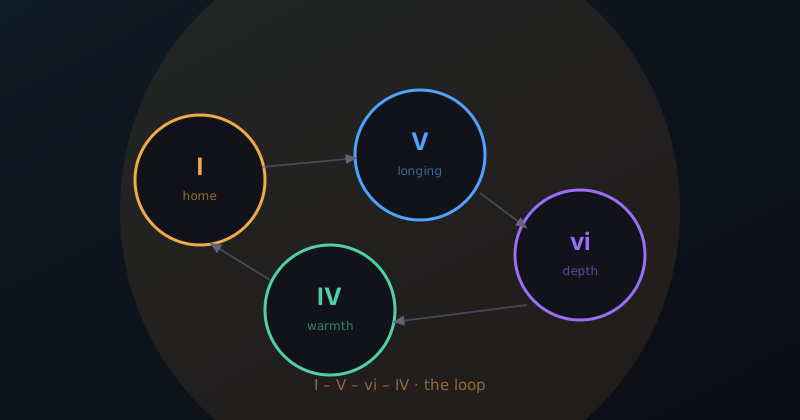
If you've listened to more than a handful of New Age piano pieces — or pop songs, or film scores, or classic rock — you've heard the I–V–vi–IV progression. In C major: C major, G major, A minor, F major. It repeats. It loops. It forms the harmonic backbone of an enormous fraction of Western music written in the last sixty years.
This is either a sign of creative poverty or a sign that the progression does something neurologically and emotionally useful enough to justify endless revisitation. The answer is the latter, and understanding why helps explain what makes New Age piano work.
What the progression actually does
Start with what each chord provides:
I (tonic) is home. It's stable, grounded, unambiguous. The listener's ear knows exactly where it is when it hears the tonic.
V (dominant) is the furthest from home. It creates tension — not dissonant tension, not uncomfortable tension, but the specific gentle longing of an unresolved question. In Western harmonic grammar, V wants to return to I.
vi (relative minor) is the emotional pivot. It shares two notes with I and one with V. When you move from V to vi, you get a small surprise: the expected resolution to I is replaced by something slightly sadder, slightly more complex. Not sad enough to darken the mood — just enough to add depth.
IV (subdominant) is the warmth chord. It's the most consonant non-tonic chord in the key, sharing two notes with I. Moving from vi to IV then back to I creates a sense of gathering and release — the feeling of coming home after a brief emotional detour.
The loop logic
What makes this progression work over a loop is the implied narrative it contains. One cycle of I–V–vi–IV feels like: stability → longing → a touch of sadness → warmth → home. That four-chord narrative is complete in itself. When it loops, it doesn't feel like repetition — it feels like a continuous present tense, like the rotation of a slowly turning wheel.
This is why New Age piano composers return to it obsessively. A single loop of a piece built on I–V–vi–IV provides enough harmonic motion to feel interesting and enough predictability to feel safe. Run it for four or eight minutes and the effect is almost meditative — the progression becomes a familiar anchor while the melody floats above it.
Why the relative minor matters so much
The vi chord is doing more work than it appears. When you move from V to vi instead of V to I — a move called a deceptive cadence — you momentarily fool the ear's expectation. This tiny surprise is part of what makes the progression emotionally engaging rather than dull.
In the context of New Age piano, the vi chord is almost always voiced softly: low volume, sustained. Its minor quality adds emotional depth without darkness. Pieces in C major that use A minor (vi) feel more contemplative, more inward, than pieces that skip the vi and go directly I–V–IV–I. The minor chord allows a moment of feeling before the warmth of IV brings you back.
Variations on the template
Experienced composers in the New Age tradition don't always use the full I–V–vi–IV sequence. Common variations:
I–vi–IV–V — shifts the emotional weight earlier, leads to V at the end for more forward momentum. Used in Starfield (A–F#m–D–E) and the Kiraro tradition generally.
I–IV–vi–V — delays the minor chord, putting warmth (IV) before depth (vi). Common in slower, more meditative pieces.
vi–IV–I–V — starts on the minor chord, giving an introspective, inward opening before arriving home. Used in First Snow (Em–C–G–D, which is vi–IV–I–V in G major).
I–V–vi–IV with a secondary dominant — occasionally a piece inserts a V/V (the dominant of the dominant) before V, adding a brief moment of brightness. Yiruma does this in several pieces; it's one of the techniques that makes his music feel slightly more dramatic than strict diatonicism.
The question of why it doesn't get boring
The honest answer is that for many listeners, it doesn't — not in New Age piano, not in pop, not in film scores. The reason is probably neurological: the I–V–vi–IV motion activates the brain's expectation and reward systems in a highly predictable cycle. Each resolution to I provides a small dopamine hit. The vi chord provides a small surprise, keeping the system engaged. The IV chord provides warmth before the payoff.
The progression is, in this sense, a machine for generating small, regular pleasure pulses — not exciting enough to be arousing, not boring enough to disengage attention. It occupies the nervous system in the same mild way that watching rain fall occupies the eyes: not demanding, but not empty.
New Age piano adds one more ingredient: the arpeggio. By spreading the chords into flowing 8th-note patterns rather than block chords, the progression becomes textural rather than punctuated. You don't hear the chord changes so much as feel them passing beneath the melody. The harmonic motion becomes part of the ambient texture, and the progression can repeat indefinitely without feeling mechanical.
Every piece in Mowjera's New Age collection uses this harmonic logic. The key changes (C, G, D, A, F, Bb, E minor) provide variety in color, but the underlying motion is the same small, reliable emotional journey — stability, longing, depth, warmth, home.