Blog
Adaptive music, in practice
Technique, Wwise/FMOD alternative comparisons, AI composition notes, and what we learn building game audio without middleware.
Filtering by #music theory — clear

How to Write a Melody That Sticks: 7 Practical Steps
Learn how to write a memorable melody with motif, contour, repetition, rhythm and tension, plus a worked four-bar example in note names and exercises.
Read the post →
Chord Progressions for Game Music: Loops That Work
Six proven chord progressions for game music with Roman numerals, concrete chords in two keys, the mood each creates and how to make them loop.

Musical Modes Explained: Dorian, Mixolydian and More
The seven modes explained with exact interval formulas, characteristic notes, a comparison table and tips for using each in compositions and game scores.

Circle of Fifths Explained: A Guide for Composers
Learn how the circle of fifths maps key signatures, relative minors and smooth modulations, with a full table of all 12 major keys.
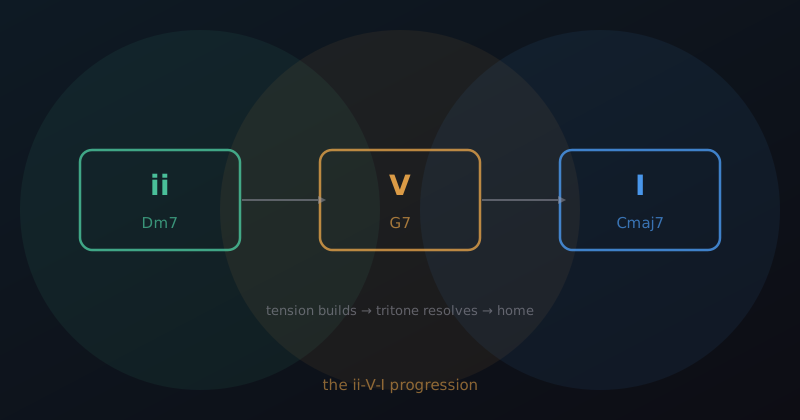
ii-V-I: The Three Chords That Define Jazz
Every jazz musician learns the ii-V-I progression on day one. Here's why it's so harmonically powerful — and why every style of jazz uses some version of it.
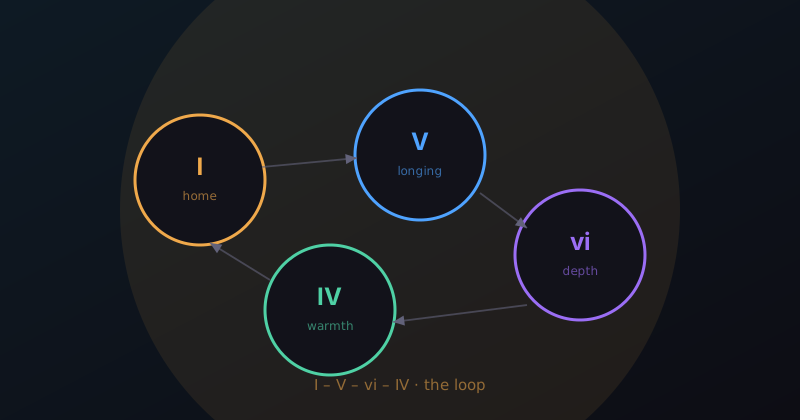
Why I–V–vi–IV Never Gets Old: The Harmony Behind New Age Piano
The I–V–vi–IV chord progression appears in thousands of pop songs and nearly every New Age piano piece — there's a neurological reason it works so well.
Hear what these posts talk about
Every technique here is live on the marketplace — adaptive states, AI drafts, real sampled instruments, playable demos.
Browse scores