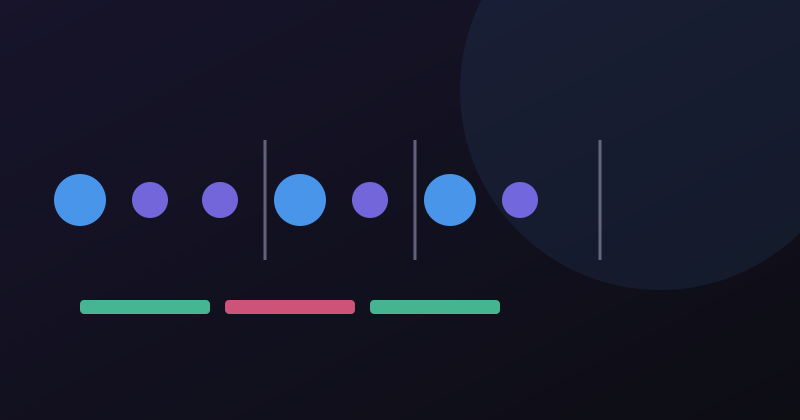
Odd time signatures give game music a distinct feel: 3/4 sways, 6/8 rolls, 5/4 leans forward unevenly, and 7/8 stumbles in an attractive way. They are practical in games as long as every loop is a whole number of bars and transitions land on bar lines. Count the bar length first, then write the loop to match it.
Last reviewed: October 2026
Why use an odd meter in a game at all?
Four-four is the default for good reasons. It is predictable, it suits drum kits, and listeners stop noticing it. That is also its weakness in a game where you want to shape how the player feels. A different meter changes the body's reaction to the music, with no change to melody or harmony.
- Unease or tension without a dissonant chord. A steady 5/4 pulse never quite settles.
- Cultural flavour. Many folk and world traditions use 6/8, 7/8 and other asymmetric groupings naturally.
- Identity. A recognisable meter can mark a faction, region or boss, so players recognise it even as the key and instrumentation change.
How does each meter feel?
Meter is not just a number of beats. It is how the beats group.
| Meter | Common grouping | Feel | Game use cases |
|---|---|---|---|
| 3/4 | 1-2-3 | Swaying, waltz-like | Towns, ballrooms, music boxes, lullaby themes |
| 6/8 | Two groups of three | Rolling, lilting, folky | Taverns, sea travel, campfires, many Middle Eastern rhythms |
| 5/4 | 3+2 or 2+3 | Leaning, restless | Chase sequences, uneasy exploration, strange machinery |
| 7/8 | 2+2+3 or 3+2+2 | Bouncy, off-kilter, energetic | Quirky platformers, bazaars, mischievous characters |
| 12/8 | Four groups of three | Slow, heavy, rolling | Epic ballads, ceremonial scenes, slow blues |
Grouping matters more than the time signature. A 7/8 bar as 2+2+3 feels different from the same bar as 3+2+2, because the long beat arrives at a different moment. Pick a grouping, then make the drums and bass show it clearly.
How do 3/4 and 6/8 differ?
They both fill a bar with six eighth notes but organise them differently. In 3/4 you count three big beats, each splitting into two. In 6/8 you count two big beats, each splitting into three. Alternating between the two feels, a device called hemiola, is a classic way to build energy without changing tempo, and it keeps a looping theme interesting on its tenth repeat.
How do you work out loop length in odd meters?
A game loop must end exactly at a bar line, and it must start the same way. A loop that stops mid-bar creates a rhythmic stumble at the seam even if the audio crossfades perfectly. Do the arithmetic before you write notes.
- Count the bar length in quarter notes. 3/4 is 3, 6/8 is 3, 5/4 is 5, 7/8 is 3.5, and 12/8 is 6.
- Choose a bar count. Four or eight bars is typical for a state; 16 bars gives more variety.
- Multiply. Four bars of 7/8 is 14 quarter-note beats. Eight bars of 5/4 is 40.
- Convert to seconds. Seconds equal quarter-note beats times 60, divided by tempo in quarter notes per minute. Four bars of 7/8 at 120 is 14 times 60 divided by 120, which is 7 seconds.
If you think in dotted-quarter pulses for 6/8, convert the tempo. A dotted-quarter pulse of 60 equals 90 quarter notes per minute, because a dotted quarter lasts one and a half quarters. Mix-ups here are a classic reason a 6/8 track feels half or twice as fast as intended. For genre tempo ranges see the BPM guide for game music.
What are the pitfalls with transitions?
Bar-aligned transitions depend on every state agreeing on where bars begin.
- Mixed loop lengths. If exploration loops every 4 bars and combat every 5, a "next bar" switch can still work, but a phrase-level switch needs a shared length. When states have different loop lengths, the combined cycle is the least common multiple, which can be long.
- Meter changes between states. Moving from a 6/8 town to a 4/4 battle on the next bar line works musically because both change at a bar boundary, but the beat the player was tapping to is gone. A short stinger or a bar of silence helps.
- Meter changes inside a loop. Mixed-meter loops, such as three bars of 4/4 and one of 7/8, are legitimate, but any engine code that computes "time to next bar" from the first bar's length will drift on the odd bar. Test it with the actual transitions you plan to use.
- Drum patterns. Standard kick-snare-hat templates assume 4/4. In odd meters, write the pattern by hand and accent the grouping.
The practical habit: render the loop, trigger a transition at several random moments in the engine, and listen for a stumble. If you hear one, check your bar maths first, not the audio.
What does Mowjera support here?
Mowjera, a browser-based DAW for adaptive game music, supports 3/4, 6/8, 5/4, 7/8, 12/8 and mixed meters through a meter map, with loops rendered as whole bars. Beats are still counted as quarter notes. The built-in drum grooves are 4/4 patterns, so in other meters you get a generic meter-aware kick, backbeat and hat pattern, and hand-written patterns will sound better. The exported metadata includes the time signature and meter map. The generated engine scripts compute the next bar from the first bar's length, so for mixed-meter scores the engine integration is only approximate. For a single odd meter, bar-aligned transitions work as expected.
To see how states connect, read what adaptive music is. For a genre where meter shapes the whole identity, see best music for platformer games. Or try the editor and set a score to 7/8.
FAQ
What is the best odd time signature for game music?
There is no single best one. 6/8 is the easiest, with a rolling folky feel. 5/4 suits restless or tense scenes, and 7/8 gives a bouncy, off-balance energy. Start with 6/8 or 3/4 if you are new, then move to 5/4 and 7/8 once grouping feels natural.
How do I loop a track in 7/8?
Make the loop a whole number of 7/8 bars. Each bar is 3.5 quarter notes, so four bars is 14 quarter-note beats. Render exactly that length, so the end meets the start at a bar line. Check the seam by looping the exported file for several minutes.
Is 6/8 the same as 3/4?
No. Both bars hold six eighth notes, but 6/8 groups them as two beats of three, while 3/4 groups them as three beats of two. That difference changes the accent pattern and the overall feel from rolling to swaying.
Do odd time signatures work with adaptive transitions?
Yes, if states share a consistent bar structure. Bar-aligned transitions need every state to define where bars start, and loops must be whole bars. Mixed meters inside a single loop are harder, because tools that calculate the next bar from the first bar's length may be approximate.
How should I count a 5/4 bar?
Count it as 3+2 or 2+3, not as five equal beats. For example, count 1-2-3-1-2 with accents on each 1. The grouping gives the music its shape. Decide on it before writing drums or bass, then keep the accents consistent across the loop.