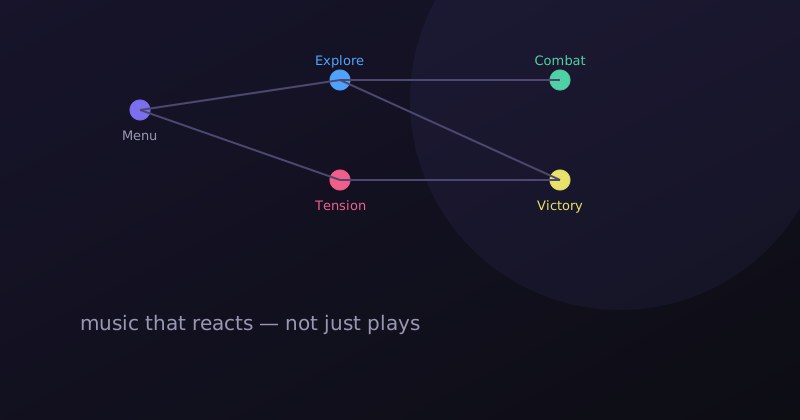
If you've searched "adaptive music" and landed here, you've probably also seen the terms "interactive music" and "dynamic music" used almost interchangeably — which makes the whole topic more confusing than it needs to be. Here's the plain-language version.
The one-sentence definition
Adaptive music is music that changes in response to what's happening in the game, instead of playing the same loop regardless of what the player does.
That's it. A game with a single looping background track has game music. A game where the music shifts from calm to intense the moment an enemy spots you has adaptive music.
A concrete example
Imagine a stealth game. Non-adaptive: one ambient track loops the entire level, whether you're hiding, sneaking, or being actively chased. Adaptive: a calm state plays while you're undetected, a tense state fades in when a guard is suspicious, and a full alarm state kicks in the moment you're spotted — then fades back to calm once you've lost them.
The player never clicks a button to change the music. The game state changes, and the music follows.
Adaptive vs. interactive vs. dynamic — do the distinctions matter?
In casual use, most developers use these terms interchangeably, and that's fine. If you want the more precise industry distinctions:
- Adaptive music — responds to game state (calm, combat, victory) — the most common meaning, and what this guide focuses on
- Interactive music — responds to direct player input (a rhythm game where your actions literally are the music)
- Dynamic music — often used as a synonym for adaptive, or sometimes specifically for continuous parameter-driven changes (volume/intensity scaling smoothly) rather than discrete state changes
For 95% of indie games, "adaptive" (state-based, discrete transitions) is the right model, and it's dramatically simpler to implement than continuous parameter systems.
Why bother? What does it actually add?
Emotional cohesion. The player feels danger through the music before they consciously register the visual threat — this is a well-documented effect in film scoring, and it works the same way in games.
Replayability without repetition fatigue. A single 90-second loop gets tiring after an hour of play. An adaptive score with 4–6 states and smart transitions feels far less repetitive, because the combination the player hears changes even when individual pieces repeat.
Perceived production value. Adaptive audio is disproportionately associated (in players' minds) with "big budget" games, because for years only well-funded productions could afford the middleware and the audio programmer time to implement it. That association is fading as tools get more accessible — which is good news if you're building something now.
The minimum viable adaptive score
You don't need six states and continuous parameter blending to get the benefit. A genuinely useful starting point is just two states:
- Explore — the default, calm state
- Combat (or "Alert," "Danger," whatever fits your game) — the intense state
Two states with one clean crossfade between them delivers most of the emotional benefit of adaptive music with a fraction of the composition and implementation effort. Add more states later once the basic loop is working.
How to actually build one
- Compose (or find) a score with named states — not a single loop, but distinct musical sections meant to alternate
- Export stems — separate audio files per state (and ideally per instrument layer) that share the same tempo and loop length
- Wire a crossfade in your engine — code (or a plugin) that fades the old state's audio out and the new state's in when your game logic calls for a transition
- Trigger transitions from gameplay events — enemy spotted, area cleared, boss defeated, whatever maps to your game's actual state changes
Mowjera handles steps 1–2 in the browser (compose, preview transitions live, export stems), and generates the code for step 3 automatically for Unity, Unreal, and Godot — leaving you with just step 4: calling one function from your existing gameplay code.
Try composing a two-state adaptive score for free — it's the fastest way to actually understand the concept, faster than reading about it.