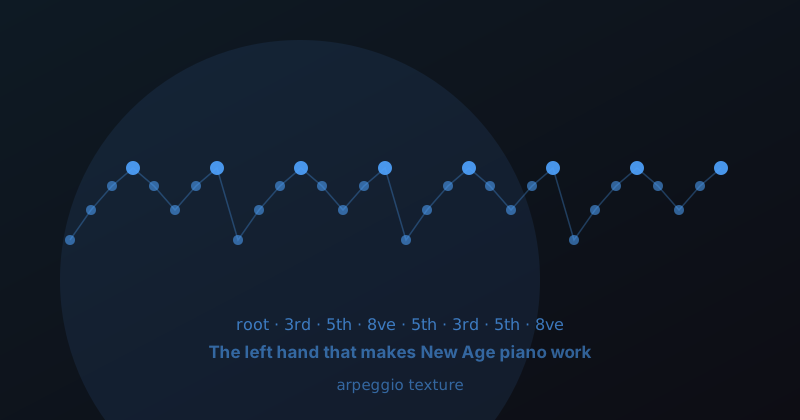
Listen to any Kiraro piece and silence the right hand mentally. What remains is the left hand: a continuous, flowing pattern of broken chords that moves without stopping for the entire duration of the piece. Root, third, fifth, octave — or some variation on that basic motion, always ascending, always returning, never pausing.
This arpeggio is not decoration. It is the primary sound of New Age piano. The melody floats above it; the bass grounds it below. But the texture the listener actually inhabits — the sonic environment they spend the duration of the piece inside — is the arpeggio. Getting it right is the difference between a piece that feels like rest and a piece that feels like practice.
What makes a good arpeggio pattern
The most common pattern in New Age piano is the ascending four-note figure: root, third, fifth, octave. In C major: C3–E3–G3–C4. This gives you one chord across four 8th notes, which at 66 BPM takes exactly 1.8 seconds to complete — slow enough to feel unhurried, fast enough to maintain flow.
After the octave, the pattern usually descends partially: back to the fifth, then the third, then up again. The full eight-note cycle is: root–3rd–5th–8ve–5th–3rd–5th–8ve. This creates a slight wave motion — the arpeggio rises to the octave, breathes back down to the third or fifth, then rises again. It's the musical equivalent of waves arriving and retreating.
The key technical point is that the individual notes overlap slightly. On piano, this means using the sustain pedal carefully — holding each note long enough to blend with the next, creating a wash rather than a sequence of distinct attacks. The perception is of a chord that moves, rather than notes that sequence. The texture is liquid.
Why arpeggios are more effective than block chords
Block chords punctuate. They create rhythmic events: a chord lands, it sustains, it ends. If you played New Age piano with block chords instead of arpeggios, you'd have a piece that feels like four chord stabs per bar — staccato, articulated, rhythmically present. The melody would sit on top of those stabs, which would create a pop-song texture rather than an ambient one.
Arpeggios dissolve the chord into time. Instead of a single event, each chord becomes a continuous motion that fills the bar. The listener doesn't hear "now it's the G chord" — they hear a quality of sound that shifts gradually. This is what allows New Age piano to function as a background to thought: there are no rhythmic events to interrupt attention, only a continuous flowing texture.
There's also a temporal effect. Arpeggios that move at a consistent 8th-note speed impose a very gentle rhythmic regularity on the music — not a strong beat (there's no accent to mark the downbeat), but a persistent pulse. This pulse is subliminal but measurable: EEG studies have shown that consistent 8th-note patterns at 60–72 BPM entrains theta brainwaves, which correspond to relaxed alertness and the hypnagogic states associated with creative flow and light meditation.
The voicing question
Where in the keyboard you place the arpeggio matters enormously. Too low and the notes muddy (the harmonic series of low notes overlap and clash). Too high and you've moved into the register where the right hand is singing — the arpeggio will compete with the melody rather than support it.
The sweet spot for New Age piano arpeggio is approximately C3 to C4 (an octave below middle C to middle C). This range is clear enough that each note is distinct, warm enough that it doesn't sound thin, and low enough that it doesn't crowd the melody register (which typically lives in the C4–G5 range).
In Crystal Morning, the guitar-acoustic voice plays the arpeggio rather than piano — partly for timbral contrast with the piano melody, and partly because acoustic guitar in the C3–C4 register has a slightly percussive attack that creates a gentle shimmer beneath the sustained piano notes. The decay characteristic of acoustic guitar (faster than piano) means each arpeggio note briefly punctuates and then fades — a natural dynamic shaping that would require careful pedaling on piano.
Left-hand independence and what it actually requires
For pianists learning to play in this style, the technical challenge is not the arpeggio pattern itself — which is entirely learnable — but the independence it requires from the right hand. The left hand needs to maintain its even, unhurried flow regardless of what the right hand is doing: holding a long note, making a large leap, playing a syncopated figure.
This is harder than it sounds. The natural tendency is for the left hand to slow down or pause when the right hand is doing something difficult. In New Age piano, that pause is exactly what you're trying to prevent — the arpeggio's continuity is the texture the piece lives in.
Practice strategy: learn the arpeggio pattern hands separately until the left hand can run on a kind of automatic. Then add the right hand melody at very slow tempo, listening specifically to whether the left hand arpeggio maintains its consistency. Any irregularity in the left hand will disturb the meditative quality the music depends on.
Arpeggio tempo and its effect
Changing the arpeggio note value from 8th notes to 16th notes at the same tempo doubles the surface density of the texture — more notes per second, more motion, more energy. This is why faster New Age pieces still feel calm: the tempo might increase to 80 BPM, but if the arpeggio stays in 8th notes, the density is unchanged. Conversely, a slow piece at 55 BPM with 16th-note arpeggios can feel more anxious than a 72 BPM piece with 8th notes.
Cloud Dreamer at 55 BPM uses 8th-note arpeggios, which at that tempo produce a very slow, spacious texture — the equivalent of wide-spaced notes that feel like breathing rather than flowing. This is deliberate: at 55 BPM, even 8th notes feel unhurried enough to contribute to the piece's floating quality rather than driving it forward.
The arpeggio is not background. It's architecture. The melody is what you hear; the arpeggio is what holds you while you listen.