Anxiety disorders are among the most prevalent mental health conditions globally, and music therapy is one of the few non-pharmacological interventions with a robust enough evidence base to appear in clinical guidelines. A 2016 Cochrane Review of music therapy for depression and anxiety found significant reductions in anxiety scores across multiple controlled trials. More recent meta-analyses have replicated those findings specifically in hospital settings, pre-surgical anxiety, cancer care, and ICU-adjacent populations.
This post covers the main techniques, the evidence behind them, and practical considerations for using music therapeutically with anxious patients or clients.
The ISO principle: meet before you lead
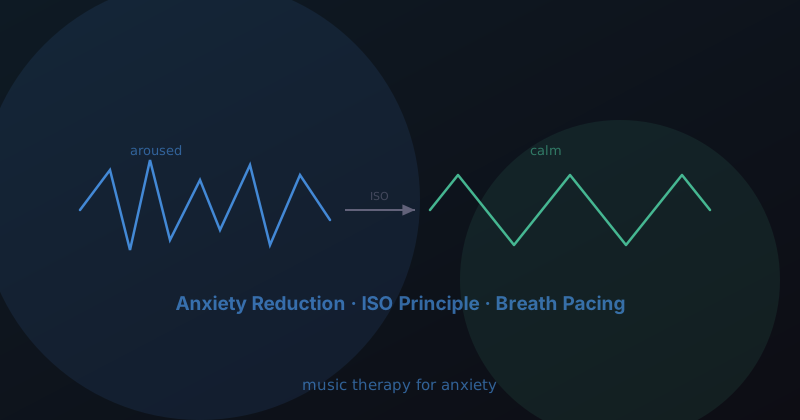
The single most important concept in music therapy for emotional regulation is the ISO principle (from the Greek isos, meaning equal). It states that therapeutic music should begin by matching the patient's current emotional state — not where you want them to end up.
Starting an anxiety session with slow, calming music is a clinical mistake. An anxious patient's nervous system is running at elevated arousal; music that feels "too calm" will be perceived as foreign, boring, or even irritating, and the patient will disengage. Instead, the therapist begins with music that matches the arousal level (slightly faster, slightly more complex), then gradually reduces tempo, harmonic complexity, and timbral brightness over the course of the session. The patient's nervous system follows, pulled downward by entrainment.
This is the principle behind Vibroacoustic Therapy, Guided Imagery and Music (GIM), and most receptive music therapy protocols for anxiety: you don't prescribe calm, you guide the patient there through a musical arc.
Breath entrainment
One of the most direct applications of music to anxiety is breath pacing. At 60 BPM, a musical phrase that lasts four beats offers a natural inhale cue; four more beats offer the exhale. This is not metaphorical — the respiratory system is highly susceptible to auditory entrainment. Studies in respiratory medicine have shown that slow, regular music reduces respiratory rate in healthy participants and in clinical populations including COPD patients and post-cardiac surgery patients.
For a music therapist, this means selecting or composing music with a clear, unambiguous beat at the target breathing tempo (typically 52–60 BPM for a 4-count inhale/exhale cycle) and presenting it during a brief psychoeducation moment: "I'd like you to try breathing in time with this melody — in for four counts, out for four counts." Most patients, even those who describe themselves as "not musical," can entrain to a clear musical cue within two or three breath cycles.
The piece "Breathing Room" in Mowjera's therapy collection was built precisely for this application: F major, 52 BPM, whole notes on the melody that visually and aurally mark the four-count breath cycle, with harmonic color underneath that doesn't compete for attention.
Progressive muscle relaxation with music
Progressive Muscle Relaxation (PMR) is a well-validated anxiety technique in which patients systematically tense and release muscle groups while attending to the sensation. Adding music to PMR has been shown to enhance the relaxation response compared to PMR alone — likely because music sustains attention and prevents mind-wandering back into anxious thoughts.
For PMR with music, selection criteria are: - Tempo 50–70 BPM - No vocals or lyrics - Minimal sudden dynamic shifts (abrupt swells or drops break the patient's attention on bodily sensation) - Slow harmonic rhythm (chord changes no faster than once every two bars)
Procedural anxiety in medical settings
One of the most evidence-rich applications of music therapy is reducing anxiety before and during medical procedures. Randomized controlled trials have demonstrated significant reductions in self-reported anxiety, as well as objective markers (blood pressure, heart rate, cortisol) in patients undergoing colonoscopy, chemotherapy infusion, cardiac catheterization, and minor surgery.
The key variable across these studies is patient choice. When patients select their own music, outcomes are significantly better than when the same music (matched for acoustic characteristics) is imposed by a therapist or researcher. Anxiety involves a sense of loss of control; restoring musical choice partially restores perceived agency, which is itself anxiolytic.
Practical implication for digital tools: a tablet app that lets a patient browse and select from a pre-vetted library of therapeutic pieces before a procedure outperforms a playlist chosen by a well-meaning nurse, no matter how carefully the nurse assembled it.
What the research cannot yet tell us
Honest clinical communication requires acknowledging gaps:
- Most music therapy trials for anxiety have small sample sizes and heterogeneous designs, making meta-analytic synthesis difficult.
- Maintenance effects (how long anxiety reduction persists after a session) are understudied.
- The relative contribution of music versus therapeutic relationship versus expectation effects has not been adequately isolated.
- Most evidence is for state anxiety (situational) rather than trait anxiety (dispositional) — whether music therapy durably reduces baseline anxiety remains unclear.
None of these gaps negate the existing evidence. They mean that music therapy for anxiety is best understood as a well-supported adjunct to evidence-based anxiety treatment (CBT, medication where indicated, exercise) rather than a standalone replacement.
Practical starting points
If you're a clinician exploring music for anxiety in your practice:
- Start with tempo matching, not tempo prescribing.
- Use wordless music unless the patient has a strong established association with specific songs.
- Give the patient as much choice as possible within a curated framework.
- Set explicit, measurable goals at the outset (GAD-7 score, STAI-S, or simply a self-report 0–10 scale before and after each session).
- Document what worked for each patient — individual responses to music are highly variable, and what works for one anxious patient may not work for another.
The anxiety pieces in Mowjera's therapy library — particularly "Breathing Room" and "Night Calm" — are documented with their acoustic parameters so you can make informed selections before a session.