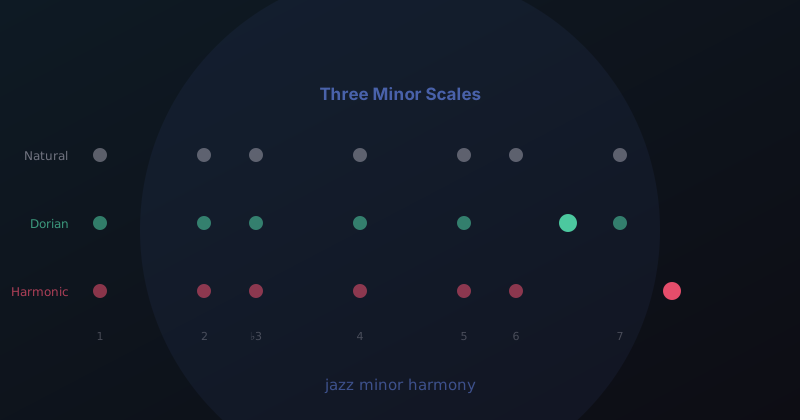
Jazz in minor keys presents a theoretical puzzle that major keys don't: the same chord (Am7, for instance) can belong to three different minor scales, each with different implications for melody and harmony. Understanding which scale is implied is the difference between a minor jazz line that sounds intentional and one that sounds like a mistake.
The three minor scales in jazz
Natural minor (Aeolian mode) is the simplest: A B C D E F G. It's the sound of folk music, medieval plainchant, and much of rock. In jazz, it's used mostly for colour — the flat 6 (F in A natural minor) and flat 7 (G) give it a slightly archaic quality.
Dorian mode (a natural minor with a raised 6th: A B C D E F# G) is the most common minor scale in jazz. The raised 6th (F# instead of F in A Dorian) gives it a brighter, more open quality than natural minor. D Dorian is the scale Miles Davis used in 'So What.' A Dorian is the scale for most Am7 chords in jazz standards.
Harmonic minor (A B C D E F G#) has a raised 7th (G# instead of G) that creates a leading tone to the tonic. This is used specifically over the V7 chord in minor keys — the E7 chord in A minor, for instance. E7 contains G#, which is the leading tone that pulls back to A. This is the scale for the E7 in Minor Swing.
How to tell which scale to use
The chord structure tells you:
- Am7 (A C E G): natural minor or Dorian. The flat 7 (G) is present; the 6th isn't specified, so you choose between F (natural minor) and F# (Dorian) based on context.
- Am(maj7) (A C E G#): harmonic minor. The major 7th (G#) is present. This chord is a tonic chord, not a dominant.
- E7 (E G# B D): harmonic minor. The G# forces you into harmonic minor, where G# is the raised 7th scale degree of A minor.
In Minor Swing
The i-iv-V7-i progression in @jazz_quartet's Minor Swing (Am7–Dm7–E7–Am) uses all three scales: - Am7: Dorian (the F# in the bass walk bar 5 confirms this) - Dm7: natural minor (D natural minor contains F natural) - E7: harmonic minor (the G# in bar 3's bass walk — E3–G#3–B3–D4 — is the harmonic minor raised 7th)
The shift from Dorian to harmonic minor on the E7 is the source of the slight darkness that E7 brings in minor jazz: suddenly G# appears, when G natural has been everywhere else. That half-step collision is the emotional core of minor jazz harmony.