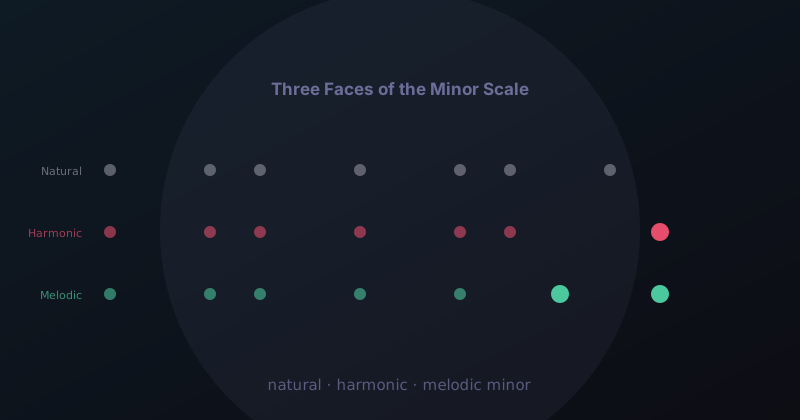
In major keys, there is one scale. In minor keys, classical music uses three different scales — sometimes within the same piece, sometimes within the same bar. Understanding why illuminates one of the most important and least-taught aspects of classical harmony.
Natural minor
The natural minor scale (also called the Aeolian mode) is built on the pattern: tone–semitone–tone–tone–semitone–tone–tone. In A natural minor: A B C D E F G A.
Natural minor has a flat seventh (G in A minor), which means it doesn't have a leading tone — a note a half-step below the tonic that creates strong upward pull. This makes V-I cadences in natural minor feel weaker than in major: G minor → A minor doesn't have the same sense of inevitability as G major → A minor.
Natural minor is used in folk music, modal music, and some Baroque pieces (particularly where a dark, archaic quality is desired). In the Romantic period, it appears often in descending bass lines: the 'descending minor tetrachord' (A G F E) became a standard bass pattern for passacaglie and chaconnes.
Harmonic minor
To fix the weak cadence problem, composers raise the seventh degree of natural minor. In A harmonic minor: A B C D E F G# A.
The G# creates a half-step pull toward A (the leading tone function), making V-I cadences strong and decisive. E major (E G# B D) is the V chord in A minor — the G# is the third of E major, the leading tone of A minor. This is why composers use harmonic minor: to create strong dominant-function chords.
The cost is an interval: between F and G# in harmonic minor is an augmented second (three semitones), which is wider than a normal scale step. This interval has a characteristic sound — slightly foreign, slightly exotic — that composers exploited for expressive purposes.
Melodic minor
The augmented second in harmonic minor is awkward for singable melodic lines. Singers find it difficult to tune accurately; it also sounds archaic in melodic contexts. To fix this, the melodic minor scale raises both the sixth and seventh degrees when ascending:
Ascending melodic minor (A): A B C D E F# G# A Descending melodic minor (A): A G F E D C B A (= natural minor descending)
The ascending form removes the augmented second by raising F to F#, creating a smooth stepwise path from the fifth to the tonic (E F# G# A). The descending form reverts to natural minor because the leading-tone urgency isn't needed going downward.
In classical pieces
@chamber_ensemble's Moonlit Adagio uses natural minor (Cm–Ab–Eb–Bb, the i-VI-III-VII progression), which gives it a floating, modal quality — the Bb7 chord at bar 4 doesn't resolve like a classic dominant. The absence of the leading tone (B natural in C minor) contributes to the piece's ambiguity.
The harmonic minor appears implicitly when the bass in the Étude in E minor ascends through scale passages: the E natural minor scale (E F# G A B C D) is used for the running passages, but the melody in bar 3 uses G5 (which suggests G major, the III chord) rather than G#, staying in natural minor territory.
These aren't inconsistencies — they're the same compositional intelligence that Bach, Mozart, and Brahms applied: use the scale that serves the melodic moment, not the one that follows a fixed rule.